The year the ‘Green Man’ was spared
Fired up about climate change: my experience at the famous welsh festival built on community, ceremony and circular solutions.
By Emma Tapp
Read time 10 minutes

Arriving at the Green Man, you’d be typically greeted by rolling hills, fields of green grass. This year, Wales was washed with a different brush; shades of brown hay. I’ve always thought wellies were a festival staple, as you swamp through layers of mud between music stages; this year, there was no mud to be seen.
It's the 24th year of The Green Man Festival, and the first time ever that the Green Man won’t be set alight in the closing ceremony where everyone traditionally gathers to watch their wishes burn. The carefully crafted characteristic wicker man, decorated with foliage and handwritten wishes, was spared in a departure from a quarter-century of tradition. But why? Well, England and Wales have witnessed over 1,000 wildfires so far this year (data shared by the National Fire Chiefs Council). With rising global temperatures and wildfires increasingly wiping out wildlife, the decision was made to opt for something different when it reached midnight on Sunday. As everyone gathered around where the Green Man was sitting, a crane began to move; instead ascending a performer, their dress lit up in a captivating display of mesmerising movement.
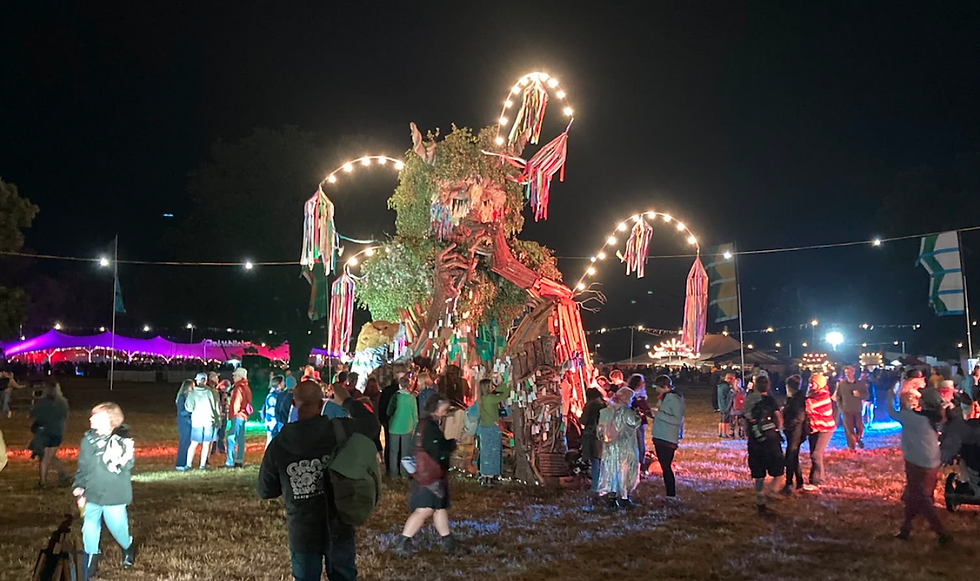
But let’s go back to the rest of the Festival.
It’s only right that the leader of the Green Party for England and Wales attended the Green Man festival. When I noticed Zack Polanski on the lineup for the ‘Babbling Tongues’ tent, in a talk with The Guardian’s investigative journalist Will Hayward, I made it my day’s mission to attend.

Polanski made it clear that we don’t have a diverse press and free media; that it is “deeply broken, deeply infested and corrupt”. Global dynasties own most of the media. In the UK, three billionaires own almost all of it. Waking up to the climate emergency relies on honest and trustworthy communication, so naturally, the need for a free media was a focus of the conversation. But what gives him hope is the journalists who are reporting on the truths across the world: “there’s been years of media lies and misinformation”, but he continues to see communities gathering on the streets to protest for a better future.
Polanski reminds us that we are living in one of the most nature-depleted places in the world. Meanwhile, press outlets such as the Daily Mail are reporting on the risks of ‘woke’ rewilding fuelling the rise in infernos across the UK, whilst blatantly ignoring the unsustainable and irreversible impacts of the fossil fuel industries on life as we know it. New Prime Minister Andy Burnham has taken a ‘pragmatic’ stance to drilling for more oil and gas in the North Sea. Polanski said the opposite is true.
“We’ve already extracted more oil and gas than we can burn and still have a liveable planet”, he said. “There are people using food banks as private planes are flying over their heads”, while companies like Shell have sat on the science for decades. A hard truth to digest for many, but an easy one to ignore. But the rising heatwaves as a consequence of human activity making the planet increasingly inhospitable can no longer be ignored. The deadly combination of rising humidity and temperatures is making it increasingly difficult for humans to cool down (a phenomenon known as wet bulb temperature). Where people feel like politics are being done to them, not with them, he noted, “everyone is incredibly despairing”.
It was clear what Polanski meant to so many at the festival from overhearing conversations after the talk, where emotions around the way modern society has challenged so many were heightened. The festival appeared to be an echo chamber for many people who are struggling with eco-emotions of hopelessness and frustration; a place to be in solidarity against those who are leading the destruction of our planet.

Festivals like the Green Man that showcase art and culture where communities come together give Polanski hope, he shared, which he believes is incredibly important. One stallholder in Einstein's Garden reminded people of the value of ‘awe’ through a tree where visitors could reflect and vote on when they feel most in awe, ‘nature’ taking the top spot.

Einstein’s Garden, a dedicated area to engage with science and nature, centered on environmentalism. It’s a place of exploration, where activists, communicators and researchers showcase how art can be a beacon for collective eco-hope through sharing discoveries. I spoke with several stall-holders. Through interaction and insightful conversation, I witnessed how accessible scientific messaging for a greener future was inspiring audiences across all ages at the festival.
"Science isn't just climate and tech, it's the stuff of everyday life too", said creative producer Lukus Robbins. He talked about how the multi-generational space is built for accessibility; a place where the academic language is stripped away. He believes it's a place where whatever your age or background, there's a way into the conversation. "At Green Man, I hope people are given a seed of an idea to engage with [...] If they can cultivate that seed through thinking, sharing, or action in their community, then Einstein's Garden has served its purpose".


As money gets poured into the destructive extraction of fossil fuels to produce plastic, Cardiff University demonstrated the potential of seaweed as a replacement. The rise in bio-materials is essential. Plastic production releases toxic chemicals into our waterways and pollution into the atmosphere, contributing to our warming climate. A lecturer from the stall demonstrated the easy and simple way plant plastic can be created; how boiling the seaweed and extracting the jelly-like liquid can transform in minutes in front of your eyes through adding plant-based chemical structures. But she explained how the infrastructure is just not there yet in the UK. With investment into the production, the process would be far more efficient and cost-effective than its fossil fuel counterpart.
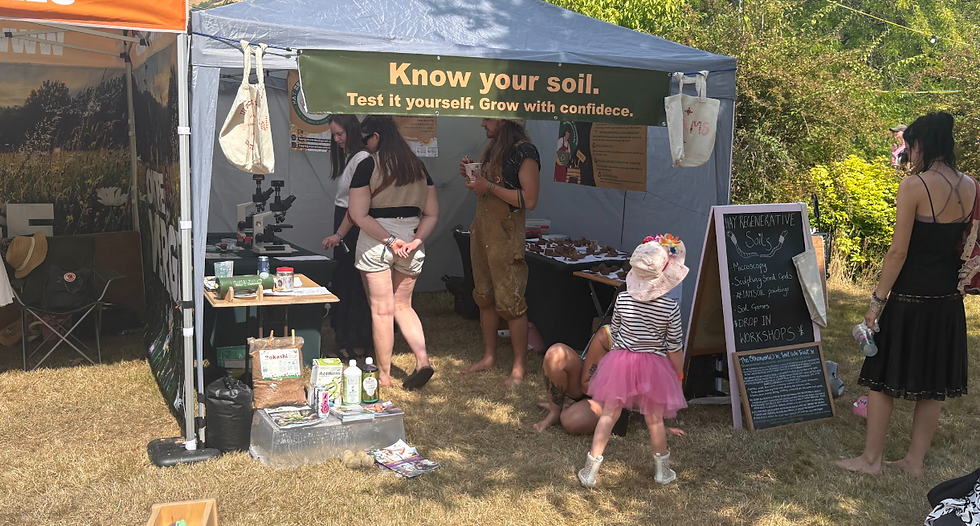
Soil microbiologist Johnny was encouraging younger festival folk to engage with the creation of clay sculptures, to help shift perceptions of soil from something ‘dirty’ into a deity. “We can understand that there's life in the soil and then maybe alter their relationship with [it]” he said. By pressing wildflowers into handmade clay ‘gods’ as an offering to the Green Man, by the spring, the flowers will grow. “We just want to make people excited about the soil”, he added. As part of Hay Regenerative Soil and On the Verge, he explained how they collect your food waste, which is then turned into nutrient-rich compost and returned to you. A circular sort of magic. Outside the tent, a sign reads: ‘Here your food waste enters not as an end, but as a passage through the unseen’.

Across the field, I discovered how urine from the women’s standing urinals was being recycled into a safe, sustainable fertiliser to grow crops and trees. This includes a patch across from the festival itself, in Abergevenny with the Forestry Commission. I spoke to George from NPK Recovery, who is working to get the nutrients from the urine that the plants need to grow. “It’s a circular process (...) we are creating new life for our world”, he said.

The scientific solutions seem to be a microcosm of the festival's themes; underpinned by pagan principles of worshipping the earth as a deity. Nature is circular, and we must live in harmony with it, giving back rather than endlessly taking.
The Glanusk Estate in the Brecon Beacons has been home to the Green Man for 20 years now, evolving from a small folk gathering of around 6,000 to a varied arts festival over the years up to a capacity of 25,000.
This is just my second year at the Green Man Festival, so I wanted to hear from someone who’s been attending the festival for over 20 years, who has noticed how the festival has evolved with its growing numbers. I spoke with Anna Turney-Easton from South Devon: “It’s always been a very ‘green’ festival, but the level of consciousness has definitely risen in the camping area”. She shared how people used to leave their tents, but new incentives have changed that so they are dropped off at the exit to be donated to refugees across the world. “It’s been cool to see how year after year they put sustainability first. We just love coming back”, she added.

Across the weekend, sustainable solutions remind you that it really is the ‘Green’ Man festival. Their environmental commitments to sustainable power, food, waste and travel are clear to see. Three of the stages run on sustainable energy and you can even charge your phone by solar power at Wild Solar (I had to pay them a visit). I also noticed how sustainable plant-based food options occupied almost every stall, while every trader must use 100% compostable packaging. The reusable cup scheme means people are incentivised to keep their cups all weekend long and return them for next year. Compost toilets where waste is recycled for farms create a circular system, and they are now even working with Peequal, reducing CO2 emissions by 98% in comparison to portaloos. Not ‘green’ enough yet? Well, I found it's just as convenient to recycle your waste as it is to throw it away, as every general waste bin you come across is accompanied by organised recycling bins.

The ‘Keep Green Man Green’ message across the festival (including on your wristband) reminds visitors each year to be part of this music-loving community rooted in a shared respect for the Earth. Amongst the mountains, where sustainability has never been simpler, where creators remind you to think circular, it’s impossible not to leave feeling hopeful we can come together in a world that is on fire.
To find out more visit: https://www.greenman.net
.


Comments